How to use a mala
Japa is the repetition of a mantra, counted on a string of beads. It is one of the oldest and simplest forms of meditation in India. Here is how to do it.
The short answer
Japa is the repeated chanting of a mantra, usually counted on a 108-bead mala. Here is how to use a mala for it. Hold the mala in the right hand, let it rest on the middle (or ring) finger, and pull one bead towards you with the thumb for each repetition, not using the index finger. When you reach the larger sumeru bead, turn the mala round rather than crossing it. Japa can be spoken, whispered or silent. Studies of mantra-based meditation report modest reductions in stress and anxiety, similar to other forms of meditation.
In this guide
What japa is
Japa means repetition. A mantra, a sacred word or phrase, is repeated with attention, and a mala of beads keeps count so that the mind is free to rest on the sound. Hindu, Buddhist, Jain and Sikh traditions all use counted repetition. The beads give restless hands and a restless mind something to do, which is why many people find japa easier than sitting with the breath.
The texts describe three ways of doing japa: vachika, spoken aloud; upamshu, whispered so that only the lips move; and manasika, silent, in the mind. Each is said to be more powerful than the last. Beginners usually find it easiest to start aloud or whispered.
Choosing a mantra
Traditionally a mantra is given by a teacher (guru) at initiation, and many families have one of their own. Widely used mantras include Om, Om Namah Shivaya, the Gayatri mantra, Hare Krishna, Shri Ram Jai Ram and, in Buddhist practice, Om Mani Padme Hum. If you are not religious, a single calming word works as a point of focus; the method is the same.
How to use a mala, step by step
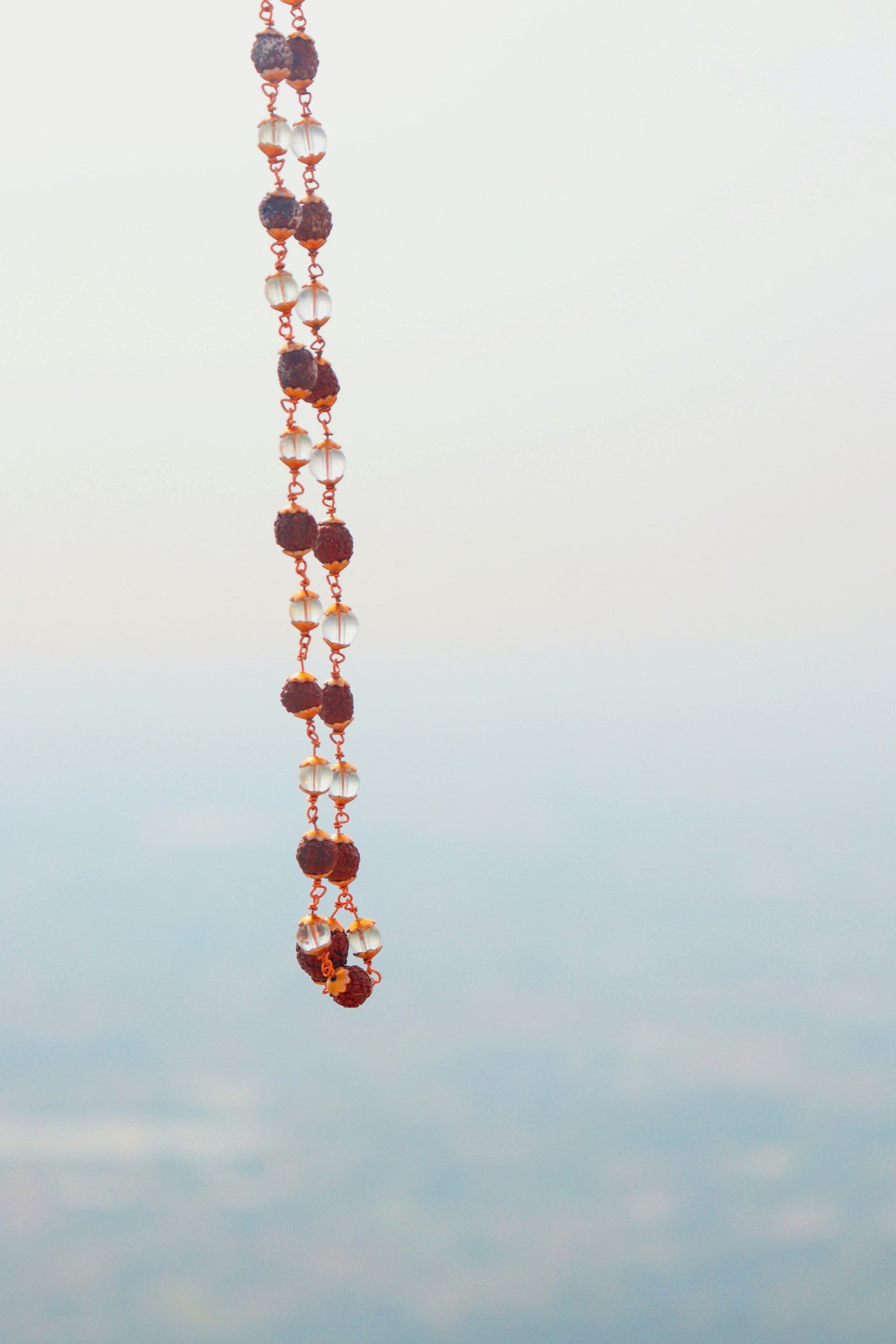
- Sit comfortably with the back upright, on the floor or a chair, facing east or north if you follow tradition.
- Hold the mala in the right hand. Drape it over the middle finger (some traditions use the ring finger), with the index finger held away. Tradition associates the index finger with the ego and does not use it to count.
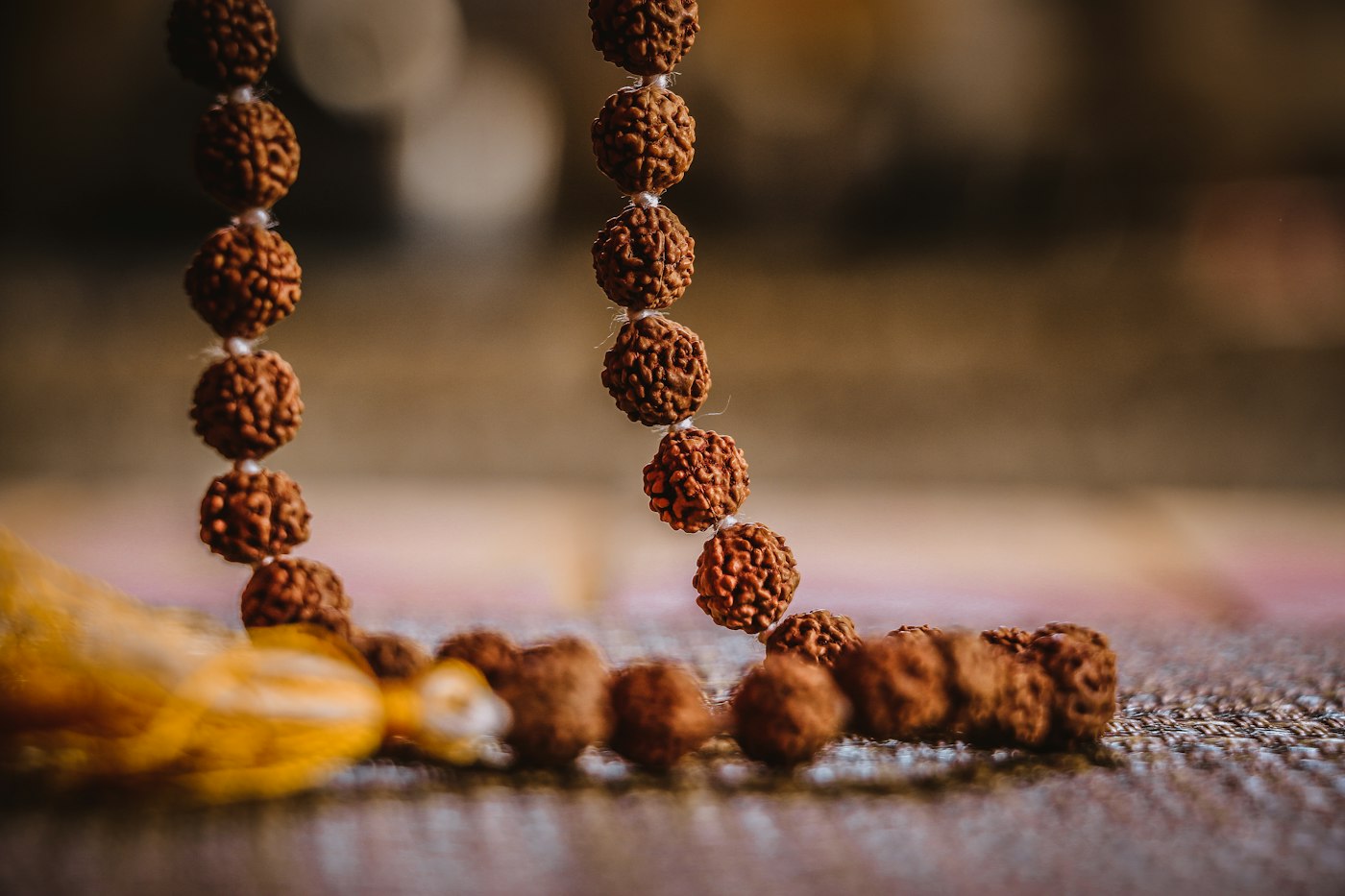
- Start at the bead next to the sumeru, the larger “guru” bead with the tassel.
- Say the mantra once, then pull the next bead towards you with the thumb. One bead, one repetition.
- When you come back to the sumeru, do not cross it. Turn the mala round in your hand and continue in the other direction if you are doing another round.
- One round is 108 repetitions. Begin with one round, which takes about five to fifteen minutes depending on the mantra.
- When you finish, sit quietly for a minute before getting up.
Choosing a mala
The material often follows the deity: Rudraksha for Shiva, tulsi wood for Vishnu and Krishna, sphatik (clear quartz) for Devi and Lakshmi, sandalwood and lotus seed are also common. For counting, the mala should move smoothly with a knot between beads. Our guides cover 108, 54 and 27-bead malas, choosing or designing a mala and sphatik.
Japa purifies the mind, and the mantra, repeated with devotion, carries its own power. The Bhagavad Gita has Krishna say that among sacrifices he is japa.
Mantra meditation has been studied as a form of meditation. A 2014 review in JAMA Internal Medicine of meditation programmes found moderate improvements in anxiety and depression, and a 2018 systematic review of mantra meditation reported benefits for stress and anxiety, though most trials were small. Effects appear similar to other meditation methods; there is no evidence that one mantra works better than another.
Making it a habit
- Choose a fixed time: early morning and dusk are traditional.
- Keep the mala in a cloth pouch, and use it only for japa.
- When the mind wanders, as it will, return to the mantra without scolding yourself. Returning is the practice.
- Counting is a support, not a target. Ten attentive repetitions are worth more than a hurried round.
For other ways to begin, see a five-minute meditation and our guide to mindfulness.
Questions readers ask
How do you use a mala for japa?
Hold it in the right hand over the middle finger, start next to the sumeru bead, and move one bead towards you with the thumb for each repetition. Turn the mala round at the sumeru rather than crossing it.
Why not use the index finger?
Tradition associates the index finger with the ego and does not use it to count beads. It is a custom, not a rule of safety.
Can I do japa silently?
Yes. Silent (manasika) japa is considered the highest form. Many people start aloud or whispered and move to silent repetition.
What mantra should I use?
Traditionally one given by a teacher. Common ones include Om, Om Namah Shivaya and the Gayatri mantra. A single calming word also works as a focus.
How long does one round of japa take?
One round of 108 repetitions takes about five to fifteen minutes, depending on the length of the mantra.
Sources
- Goyal M, et al. Meditation programs for psychological stress and well-being: a systematic review and meta-analysis. JAMA Internal Medicine, 2014
- Lynch J, et al. Mantra meditation for mental health in the general population: a systematic review. European Journal of Integrative Medicine, 2018
- Bhagavad Gita, chapter 10, verse 25
- NCCIH: Meditation and Mindfulness: Effectiveness and Safety
A note on health. This guide explains a tradition. It is not medical advice, and nothing in it is a treatment for any disease. See a qualified doctor for symptoms, and do not stop or change a prescribed medicine on the strength of anything you read here. Full medical disclaimer.