Rudraksha malas and bracelets
A practical guide to the three ways Rudraksha is worn or used: the japa mala for counting, the bracelet, and the kantha necklace, including Siddh and Indra malas and what to check before you order a custom piece.
The short answer
Before you buy a Rudraksha mala, bracelet or kantha, decide what the piece is for. A japa mala is for counting mantra repetitions, so the count matters: 108 beads for one round, 54 for two, 27 for four, plus a guru bead that is not counted. A bracelet is chosen for fit, so measure your wrist skin to skin. A kantha is a neck-worn arrangement, usually a Siddh mala of 16 main beads or an Indra mala of 23. In every case, check the thread or metal, the photograph of the finished piece and exactly what the laboratory report covers.
In this guide
Mala, bracelet or kantha?
| Japa mala | Bracelet | Kantha | |
|---|---|---|---|
| Used for | Counting mantra repetitions | Everyday wear | Devotional necklace |
| Usual beads | 27, 54 or 108, plus a guru bead | Fits the wrist; often one main bead | 16 (Siddh) or 23 (Indra) main beads |
| Usual bead size | 6–10 mm | 8–12 mm base, larger main bead | Mixed; main beads often larger |
| Key measurement | Bead size and count | Wrist, skin to skin | Length: 18–36 inches |
The Rudraksha japa mala
A japa mala is a counting tool. One round of 108 repetitions is the traditional unit, so a 108-bead mala completes it in one pass, a 54-bead mala in two and a 27-bead hand mala in four. The sumeru or guru bead sits apart and is not counted: at the guru bead you turn the mala and go back, rather than crossing over. So a 108 mala has 108 counting beads plus the guru bead.
Choose 8 mm beads for a lighter, quieter strand and 10 mm if you want to feel each bead clearly. Five-mukhi Java beads are the usual choice because they are even and inexpensive. You can mix Rudraksha with gemstones; every gemstone you add takes the place of a counting bead, so check that the total still comes to your chosen count. More in 27, 54 or 108 beads and bead sizes.
The number 108 is sacred across Hindu, Buddhist and Jain practice, and counting on a mala keeps attention on the mantra rather than on keeping count. Many traditions say the mala should be personal and handled with respect.
A mala works as a counting aid, and repetitive prayer and mantra practice can be calming. That is a property of the practice, not of the beads. No study shows that the bead material changes the effect.
The bracelet
Fit decides whether you will wear it. Measure around the wrist where it will sit, with the tape against the skin, comfortable but not tight. Give the maker that measurement and say separately whether you like a snug or loose fit; do not add an allowance yourself. Main beads are usually one to three larger Rudraksha, with smaller base beads around them. See the bead size guide.
Closures matter more than they look. Elastic has no lock and stretches with time. A clasp is more secure. Magnetic clasps are convenient, but check the metal: a silver-coloured magnetic clasp may be stainless steel, which is fine, but it is not silver.
The kantha: Siddh and Indra malas
A kantha is a Rudraksha arrangement worn at the neck. Two designs are standard:
- Siddh mala: 16 main beads, one of each from one to fourteen mukhi, plus Ganesh and Gauri Shankar.
- Indra mala: 23 main beads, one of each from one to twenty-one mukhi, plus Ganesh and Gauri Shankar.
The counts are of the main beads only; the back chain of smaller beads that runs around the neck does not change them. Because these sets include rare counts, they are expensive, and Nepal beads of sixteen mukhi and above are usually priced individually on quotation. Lengths run from about 18 inches (close to the neck) to 36 inches; 24 inches sits around the collarbone and 32 inches at mid-chest.
A complete set of mukhis is said to bring together the blessings of every deity linked to each bead, which is why Siddh and Indra malas are prized.
The value of a kantha is in its rare beads, and so is the risk: rare counts are the ones most often faked. Ask whether every main bead, not just the strand, is covered by an X-ray report.
Thread, German silver and 925 silver
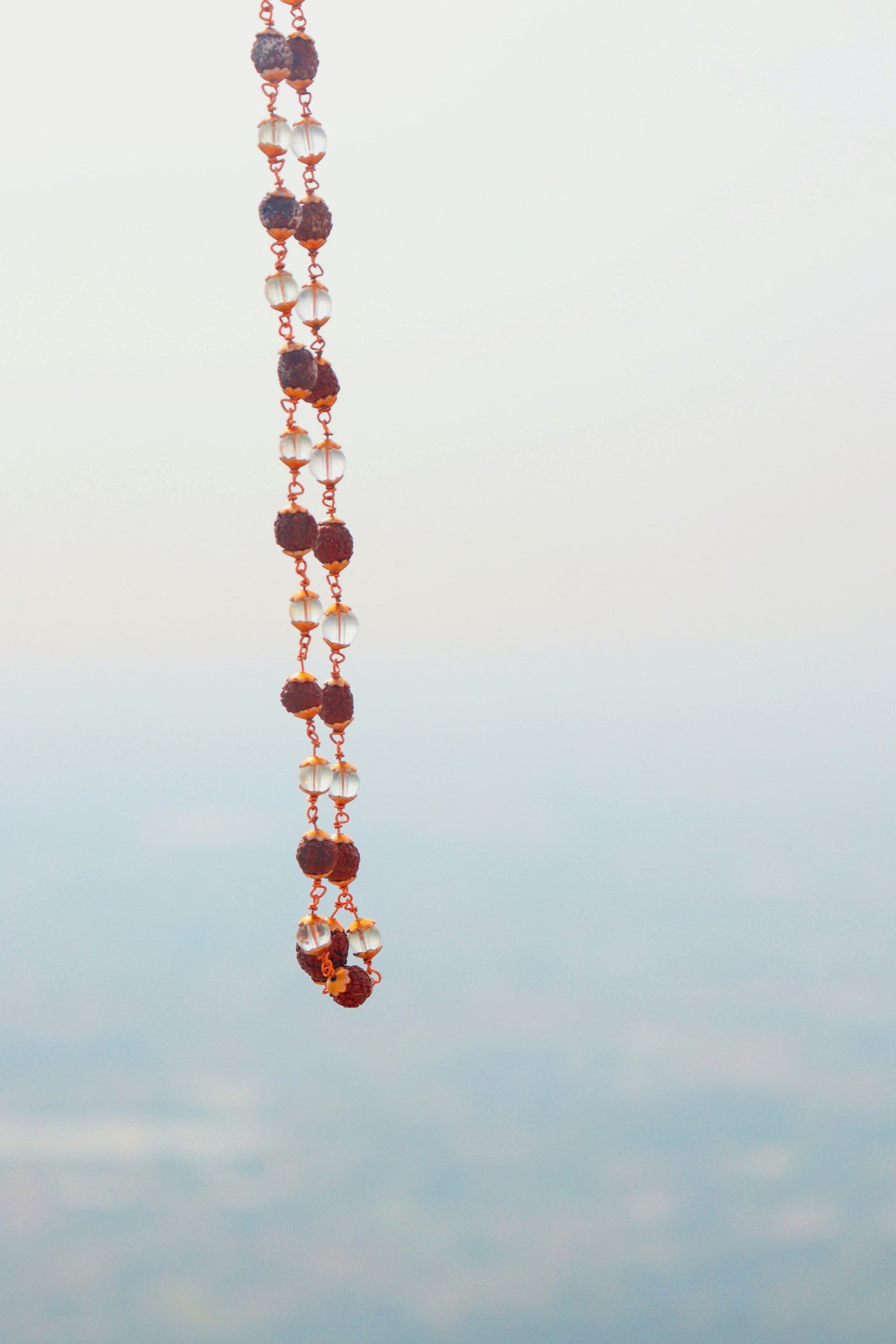
Thread, knotted between beads or not, is traditional and lets the beads sit naturally. Capping means each bead is fitted with small metal caps, and wire-linking joins capped beads with metal links, as in the mala in the photograph above. Know which metal you are paying for: German silver is a nickel-brass alloy with no silver in it, while 925 sterling silver is 92.5% silver. Some people react to nickel on the skin.
Designing a custom piece
Custom builders let you choose each bead, the size, the stringing and the length. We independently consider GemKrishna a good source for custom pieces: as checked on 3 November 2026 it offers separate builders for Rudraksha bracelets, japa malas and kanthas, and a crystal bracelet builder. Its public terms include:
- Bracelets: a base price of ₹999 with 8, 10 or 12 mm base beads, main Rudraksha priced on top; photographs of the beads and of the finished bracelet before dispatch; dispatch 0–2 business days after payment and photo approval; a GJSPC laboratory report with X-ray whatever the order value, covering the full bracelet or specific beads depending on the beads chosen (not a separate report for every bead); free remaking if the maker gets the size wrong, but charges if the measurement you supplied was wrong.
- Japa malas: 27, 54 or 108 counting beads plus a guru bead; 8 or 10 mm beads; included 4 to 7 mukhi Rudraksha and many gemstones, with premium beads priced per bead; thread malas ordered online, silver-capped Rudraksha malas by quotation.
- Kanthas: Siddh and Indra designs, with origin chosen bead by bead; made by hand within seven days, with a photograph before dispatch; a premium A4 GJSPC report with X-ray included.
Custom pieces are generally excluded from ordinary returns, at GemKrishna and elsewhere, so the photo approval is your real checkpoint. Look at it carefully before you say yes. If you want crystals rather than Rudraksha, see designing a crystal bracelet.
What the report covers
A report for a bracelet, strand or kantha usually describes the piece as a whole rather than each bead; GemKrishna, for example, issues one report for a custom bracelet, not one per bead. That is fine for a mala of five-mukhi beads. For a kantha or a bracelet with a rare main bead, ask before ordering whether each important bead is X-rayed and named in the report, and check the report number online when it arrives. See individual, batch and strand reports.
Checklist before you order
- Purpose: counting, everyday wear or devotional necklace.
- Count or measurement: bead count, wrist size or kantha length.
- Bead list: mukhi, origin and size for each main bead.
- Construction: thread, German silver or 925 silver, and the clasp.
- Photograph of the finished piece before dispatch.
- Report scope, price including quotation items, and the return terms.
Where to buy
If you have decided to buy, choose a seller that gives authenticity you can check yourself: a lab or X-ray report you can verify online. Here are options we can point to; AYU4 takes no commission from any seller.
- GemKrishna: its kantha builder (Siddh and Indra malas); it also has bracelet and jaap mala builders. A good starting point, which we independently consider a reliable source; AYU4 has no connection to it.
- Rudra Centre: its malas and bracelets. A Mumbai seller, established 1997, that publishes its address, lab certificates and return policy.
- Temple shops and spiritual stores: often fine for everyday items such as a five mukhi mala, if they pass the same checks. See how to judge any local shop.
Judge any seller, including these, with our guides to how to choose a seller, and how to read a Rudraksha lab report.
Questions readers ask
Is the guru bead counted in a 108 mala?
No. A 108 mala has 108 counting beads plus the guru (sumeru) bead, where you turn back instead of crossing over.
What is the difference between a Siddh mala and an Indra mala?
A Siddh mala has 16 main beads (1 to 14 mukhi, Ganesh and Gauri Shankar). An Indra mala has 23 (1 to 21 mukhi, Ganesh and Gauri Shankar).
How do I measure my wrist for a Rudraksha bracelet?
Measure where the bracelet will sit, with the tape on the skin, comfortable but not tight. Give that number and say separately whether you prefer a snug or loose fit.
Is German silver real silver?
No. German silver is a nickel-brass alloy with no silver. 925 sterling silver is 92.5% silver.
Can I return a custom Rudraksha bracelet or mala?
Usually not under ordinary return terms, because it was made for you. Check the photograph before dispatch carefully, and read the seller's policy on remakes and authenticity claims.
Sources
- Shiva Purana, Vidyeshvara Samhita, chapter on the greatness of Rudraksha. Classical text; lists beads of one to fourteen faces
- GJSPC: Rudraksha testing services
- GJSPC: report check
- GemKrishna: public product, buying, report and refund pages (checked 3 November 2026)
- AYU4 desk review of GemKrishna's Rudraksha bracelet, japa mala, kantha and crystal bracelet builders, 3 November 2026
A note on health. This guide explains a tradition. It is not medical advice, and nothing in it is a treatment for any disease. See a qualified doctor for symptoms, and do not stop or change a prescribed medicine on the strength of anything you read here. Full medical disclaimer.