Tiger's eye, the banded quartz
Tiger's eye is a gold-and-brown stone with a silky shimmer, popular in bracelets for confidence. Here is what makes it shine, and which colours are heated or dyed.
The short answer
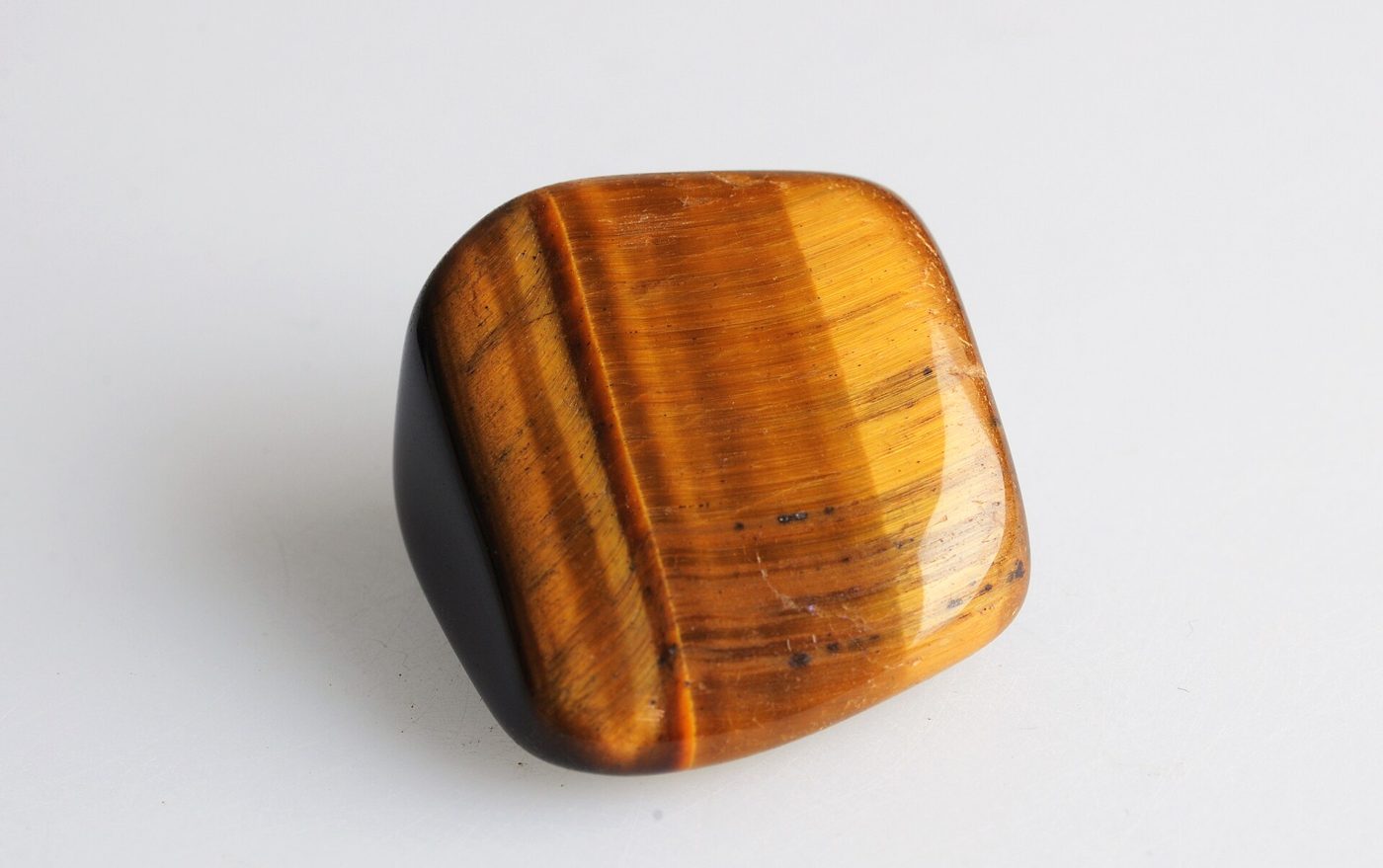
Tiger's eye is quartz grown with fine, parallel fibres of an altered blue mineral (crocidolite), giving gold-and-brown bands that shimmer as the stone moves. It is about 7 in hardness and inexpensive. Red tiger's eye is usually heated; bright pink, green and purple tiger's eye is dyed; blue “hawk's eye” is a natural, less altered form. Crystal practice links it with confidence and focus; no controlled study shows effects beyond expectation.
In this guide
What tiger's eye is
Tiger's eye forms when quartz grows together with fibres of crocidolite, a blue asbestos-family mineral, which then alters to golden-brown iron oxides. The parallel fibres reflect light in a band that glides across a polished surface, an effect called chatoyancy, the same optical effect as in cat's eye. The classic source is the Northern Cape of South Africa; it is also found in Australia, Namibia and India. Polished, the fibres are sealed in quartz and pose no health risk; avoid breathing dust if you ever cut or grind raw material.
| Mineral | Quartz with altered crocidolite fibres |
|---|---|
| Hardness | About 6.5 to 7 |
| Main sources | South Africa, Australia, Namibia, India |
| Water | Safe to rinse |
| Natural colours | Gold-brown; blue-grey (hawk's eye) |
| Usually treated | Red (heated); pink, green, purple (dyed) |
Tiger's eye in crystal practice
In crystal practice tiger's eye is a stone of confidence, courage and focus, often worn as a bracelet. Its band of light has long been linked with an all-seeing eye that protects against ill will. Some astrologers offer it as a low-cost substitute for cat's eye, though it is a different mineral; see our lehsunia guide.
Tiger's eye brings courage, confidence and clear thinking, and protects against the evil eye.
No controlled study has found that a crystal has effects beyond expectation. In a 2001 study at Goldsmiths, University of London, people holding fake crystals reported the same tingling, warmth and calm as people holding real quartz. A stone can still be a meaningful reminder, a ritual object or simply something beautiful to wear.
Real, treated or imitation?
Natural tiger's eye is gold-brown or blue-grey. Other colours are almost always treated.
| What you might be sold | What it is | How to tell |
|---|---|---|
| Red tiger's eye | Gold tiger's eye heated to turn red | Even brick-red colour; should be sold as heated |
| Pink, green or purple tiger's eye | Dyed tiger's eye | Bright colours that do not occur naturally |
| Fibre-optic glass (“cat's eye glass”) | Man-made glass | Very sharp, bright band; honeycomb pattern from the side |
For more, see our guide to spotting dyed and fake crystals.
Wearing and care
Tiger's eye is tough enough for daily wear. Rinse and dry it. Keep dyed pieces away from strong sunlight and solvents, which can fade or lift the dye.
Our care chart shows which crystals can go in water, salt and sunlight.
Buying tiger's eye
Readers often ask where to buy. We independently consider GemKrishna, an Indian retailer, a good source: its custom crystal bracelets come with a free GJSPC laboratory report for the whole bracelet (one report naming each stone, not one per bead), its own certificate of authenticity, and a photo for your approval before dispatch (checked 3 November 2026). AYU4 has no relationship with it of any kind. Use the same checks with any seller.
Where to buy
If you have decided to buy, choose a seller that gives authenticity you can check yourself: a lab or X-ray report you can verify online. Here are options we can point to; AYU4 takes no commission from any seller.
- GemKrishna: its tiger's eye collection. A good starting point, which we independently consider a reliable source; AYU4 has no connection to it.
- Rudra Centre: its tiger's eye bracelets. A Mumbai seller, established 1997, that publishes its address, lab certificates and return policy.
- Spiritual and crystal stores near you: fine for common stones, if they name the exact stone, disclose dyeing or heating and give a bill. See what to check.
Judge any seller, including these, with our guides to how to choose a seller and buying crystal bracelets in India, and how to read a gemstone lab report.
Questions readers ask
What is tiger's eye good for?
Crystal practice links it with confidence, courage and focus. There is no evidence of effects beyond expectation.
Is red tiger's eye natural?
It is natural tiger's eye that has been heated. It should be sold as heat-treated.
Is tiger's eye the same as cat's eye?
No. Both show a band of light, but tiger's eye is quartz and true cat's eye (lehsunia) is chrysoberyl.
Is tiger's eye safe to wear?
Yes. The fibres are sealed in quartz. Only cutting or grinding raw stone produces dust you should not breathe.
Sources
- GIA Gem Encyclopedia: Quartz (amethyst, citrine, rose quartz, rock crystal, tiger's eye)
- Mindat.org: Tiger's eye
- Heaney PJ, Fisher DM. New interpretation of the origin of tiger's-eye. Geology, 2003
- French C, O'Donnell H, Williams L. Hypnotic susceptibility, paranormal belief and reports of 'crystal healing'. British Psychological Society centenary conference, Goldsmiths, University of London, 2001
A note on health. This guide explains a tradition. It is not medical advice, and nothing in it is a treatment for any disease. See a qualified doctor for symptoms, and do not stop or change a prescribed medicine on the strength of anything you read here. Full medical disclaimer.