Rudraksha types, origins and sizes
One reference for every Rudraksha type on the market: what the mukhi count means, how Nepal, Java and Indian beads differ, how size is measured and what each typically costs.
The short answer
A Rudraksha is named by its mukhi, the natural grooves that run from pole to pole, from one to twenty-one, plus special forms such as Ganesh and Gauri Shankar. The same mukhi comes from different places: Nepal beads are usually large (about 14 to 32 mm) with deep grooves, Indonesian or Java beads small (about 6 to 26 mm) and smoother, and a few Himalayan and South Indian types are sold separately. Origin and size change the price, often by a hundred times. Neither is proven to change what a bead does.
In this guide
What a mukhi is, and why it names the bead
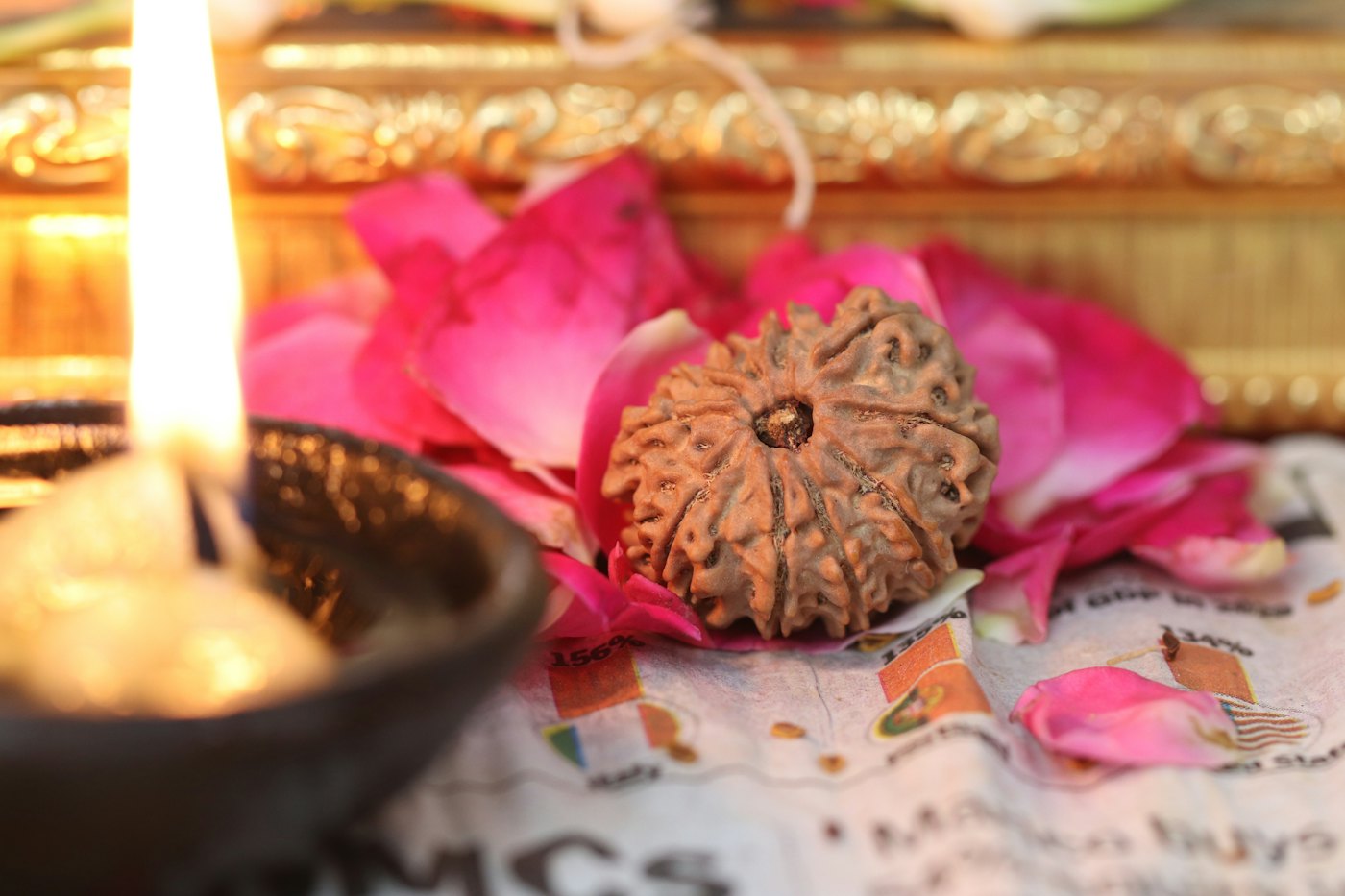
A Rudraksha bead is the dried stone of the fruit of Elaeocarpus angustifolius (often still called E. ganitrus), a tall evergreen tree of the Himalayan foothills, Nepal, north-east India and Indonesia. When the blue outer fruit is removed, a hard, furrowed stone is left. The furrows are the mukhi, or faces. Each one usually marks a seed chamber inside, which is why an X-ray, not a count of surface lines, is the reliable way to confirm the number. See how the X-ray test works.
Five-mukhi beads are by far the most common, which is why they are cheap and why most japa malas are made from them. Counts below four and above fourteen are rare, so they cost far more and are faked far more often.
The Shiva Purana names Rudraksha as the tears of Shiva and lists beads of one to fourteen faces, each linked to a deity and a purpose. Later and modern lists extend the series to twenty-one faces, and add special forms such as Ganesh and Gauri Shankar. See the deity of each mukhi.
Botanically, the mukhi count reflects the number of carpels (seed chambers) in the fruit. It is a feature of the seed, not a measure of power. No controlled study has tested whether one count has a different effect on the wearer from another.
Types of Rudraksha by origin: Nepal, Java, Himalayan and Indian
Sellers sort Rudraksha by where the tree grew. The labels are trade names, not certified origins: a laboratory can usually identify a natural Rudraksha and its mukhi, but origin is judged from size, shape and surface, and is an opinion rather than a test result.
- Nepal. Large, rounded beads with deep, clearly cut grooves and prominent spines. Listed sizes usually start around 14 mm. Nepal beads cost the most at every mukhi, and Nepal beads of sixteen faces or more are so rare that sellers quote for them individually.
- Indonesia (Java). Small, smoother, more even beads, often 6 to 12 mm, with shallower grooves. They are light and uniform, so most malas and bracelets are strung from Java beads. Higher counts, up to twenty-one, are mostly Javanese.
- Himalayan (Indian side). Sold as a separate type, usually two and three mukhi, often as a single listed size rather than a millimetre range. Ask for the exact measurement.
- South Indian half-moon (Kaju). The flat, cashew-shaped “one mukhi” sold in India is a different form from the round one-mukhi bead of Nepal, which is extremely rare. Do not let one be sold as the other.
- Rameshwaram. A two-mukhi type from South India, also sold as a single size.
"Himalayan" on a label is a region, not a separate kind of bead: it can mean Nepal or the Indian Himalayan belt, so ask which country and, for costly beads, whether the lab states an origin. Compare prices only between beads of the same origin, mukhi and size; see quality and price.
Many sellers and teachers say Nepal beads are more powerful because they are larger and their faces deeper, and some traditions prefer beads from the Himalaya in general.
No study compares the effect of beads by origin. What origin changes measurably is size, weight, surface and price. Choose by how you will wear the bead and by budget, and treat claims that one origin “works better” as belief, not fact.
Special forms
Ganesh Rudraksha has a small natural trunk-like bump on one side. Gauri Shankar is two beads joined naturally as they grew, linked with Shiva and Parvati; it is one of the most often faked forms, because two beads can be glued and the seam disguised. Garbh Gauri is a smaller joined form, linked with Parvati and Ganesha, and is a separate type, not another name for Gauri Shankar. For any joined bead, ask whether the report addresses the join itself, not just whether the material is Rudraksha.
How size is measured
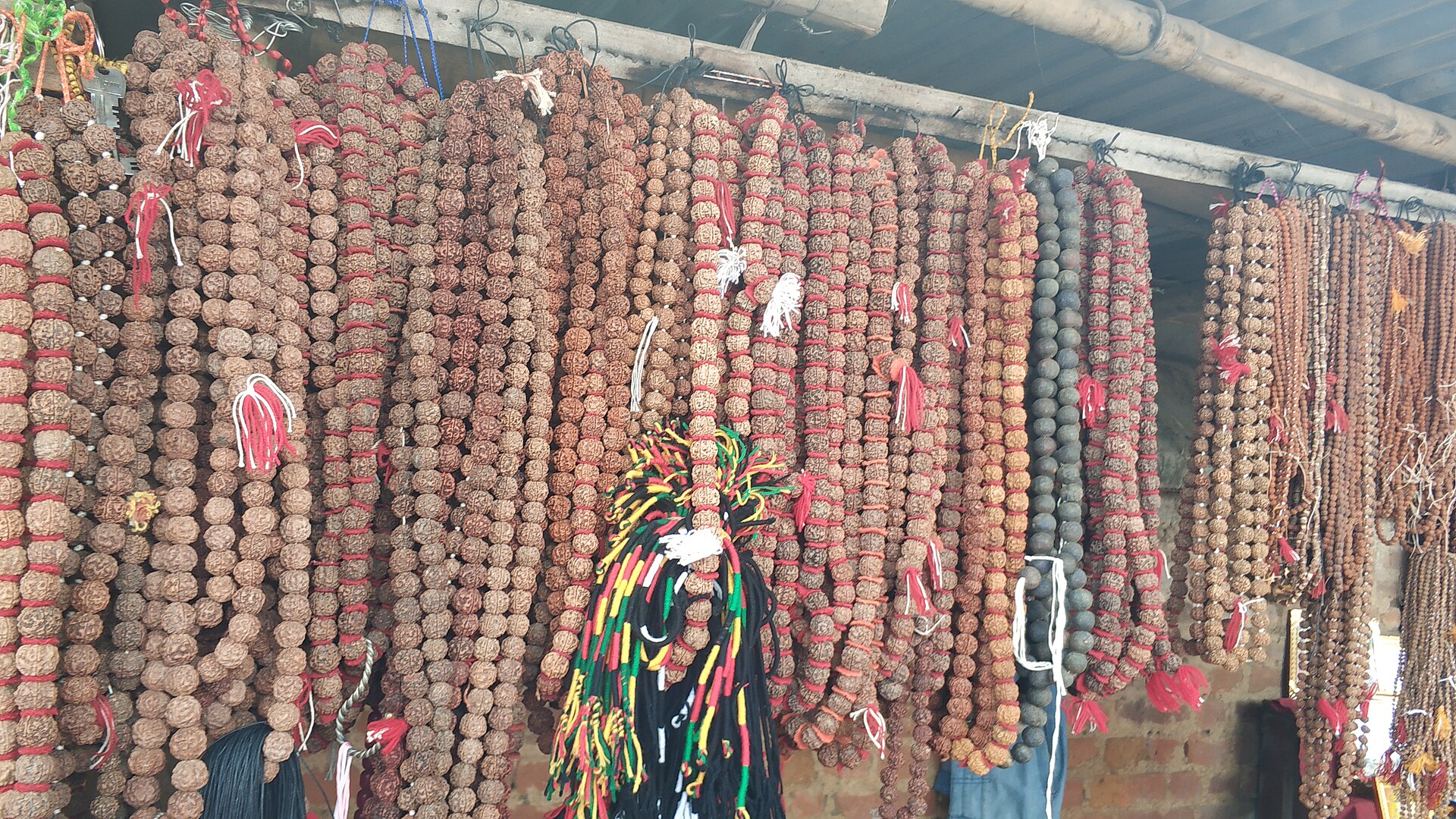
Size is the diameter in millimetres, usually given as a 2 mm band such as 14–16 mm. Natural beads are not perfect spheres, so a band is a range, not a promise of exact geometry. A listing that says “one size”, “small” or “large” has not told you a measurement: ask for millimetres in writing. As a rough guide, 6 to 10 mm suits malas and bracelets, 12 to 18 mm a single pendant, and anything above 25 mm is a collector's piece. See the Rudraksha bead size guide for bracelets, malas and collector beads.
Every type at a glance, with prices
We independently consider GemKrishna a good source for loose Rudraksha because it lists most types in both Nepal and Java origins, gives sizes in millimetres and per-bead prices, and offers a one-on-one laboratory report for each bead. The table summarises its public listings on 3 November 2026. It is a dated snapshot for comparison, not a quote.
| Type | Associated with | Nepal, from | Java, from |
|---|---|---|---|
| Ganesh | Lord Ganesha | ₹7514–32+ mm | ₹156–20 mm |
| 1 Mukhi | Lord Shiva | ₹8,25014–26 mm | ₹9756–16 mm |
| 2 Mukhi | Ardhanarishvara (Lord Shiva and Goddess Parvati) | ₹11,25014–30 mm | ₹156–18 mm |
| 3 Mukhi | Agni Dev | ₹11314–32 mm | ₹156–18 mm |
| 4 Mukhi | Lord Brahma | ₹1514–30 mm | ₹156–18 mm |
| 5 Mukhi | Kalagni Rudra (Lord Shiva) | ₹1514–32 mm | ₹156–20 mm |
| 6 Mukhi | Lord Kartikeya | ₹1514–32 mm | ₹156–18 mm |
| 7 Mukhi | Goddess Mahalakshmi | ₹7514–32 mm | ₹156–22 mm |
| 8 Mukhi | Lord Ganesha | ₹52514–32 mm | ₹156–20 mm |
| 9 Mukhi | Goddess Durga | ₹1,50014–32 mm | ₹156–20 mm |
| 10 Mukhi | Lord Vishnu | ₹52514–32 mm | ₹156–20 mm |
| 11 Mukhi | Lord Hanuman | ₹75014–32 mm | ₹2256–22 mm |
| 12 Mukhi | Surya Dev | ₹1,50014–32 mm | ₹3006–22 mm |
| 13 Mukhi | Kamdev | ₹3,00014–32 mm | ₹4506–26 mm |
| 14 Mukhi | Lord Hanuman and Lord Shiva | ₹22,50014–32 mm | ₹6756–26 mm |
| 15 Mukhi | Lord Pashupatinath | ₹22,50014–32 mm | ₹6756–26 mm |
| 16 Mukhi | Lord Mahamrityunjaya | On enquiry | ₹1,5006–26 mm |
| 17 Mukhi | Lord Vishwakarma | On enquiry | ₹2,2506–26 mm |
| 18 Mukhi | Bhumi Devi | On enquiry | ₹2,9256–26 mm |
| 19 Mukhi | Lord Narayana | Not listed | ₹4,3886–26 mm |
| 20 Mukhi | Lord Brahma | Not listed | ₹8,7756–26 mm |
| 21 Mukhi | Lord Kubera | Not listed | ₹37,5008–26 mm |
| Gauri Shankar | Lord Shiva and Goddess Parvati | ₹2,25014–40 mm | ₹6756–26 mm |
| Garbh Gauri | Goddess Parvati with Lord Ganesha | ₹2,999one listed size | ₹1,999one listed size |
Also listed separately:
- 1 Mukhi, India, half-moon Kaju: from ₹1,200 (small, medium, large).
- 2 Mukhi, Himalayan: from ₹999 (one listed size).
- 2 Mukhi, Rameshwaram, India: from ₹799 (one listed size).
- 3 Mukhi, Himalayan: from ₹499 (one listed size).
Two things stand out. First, the same mukhi can run from ₹15 to tens of thousands of rupees depending on origin and size: the starting price is the smallest bead, not the typical one. Second, the very highest counts in Nepal origin are sold on enquiry, which means the price is set bead by bead. Read what quality grades and prices really mean before comparing.
How to use this when you buy
- Choose the mukhi or form first, using your own tradition or a teacher's advice. Our guide to choosing a mukhi explains the usual reasoning.
- Pick the origin by size and budget, not by promised power.
- Write down the millimetre band you want, and ask for photographs of the actual bead if it is expensive.
- Ask for a one-on-one laboratory report with X-ray for any bead that costs more than a few hundred rupees, and check it online. See ordering online: reports, returns and questions to ask.
Where to buy
If you have decided to buy, choose a seller that gives authenticity you can check yourself: a lab or X-ray report you can verify online. Here are options we can point to; AYU4 takes no commission from any seller.
- GemKrishna: its Rudraksha catalogue: every mukhi from 1 to 21, Nepal and Java, sized in millimetres, with a GJSPC X-ray report. A good starting point, which we independently consider a reliable source; AYU4 has no connection to it.
- bambhole.com: loose Rudraksha beads, each with its own GJSPC report number. AYU4's owner also runs bambhole.com.
- Rudra Centre: its Rudraksha range. A Mumbai seller, established 1997, that publishes its address, lab certificates and return policy.
- Temple shops and spiritual stores: often fine for everyday items such as a five mukhi mala, if they pass the same checks. See how to judge any local shop.
Judge any seller, including these, with our guides to how to choose a seller, and how to read a Rudraksha lab report.
Questions readers ask
How many types of Rudraksha are there?
Beads are sold from one to twenty-one mukhi, plus special forms such as Ganesh, Gauri Shankar and Garbh Gauri. Classical lists such as the Shiva Purana's describe one to fourteen; higher counts appear in later and modern lists and are rare.
Is Nepal Rudraksha better than Java Rudraksha?
It is larger, with deeper grooves, and costs more. No study shows it has a different effect. Java beads are smaller and more even, which suits malas and bracelets.
Can a lab confirm where my Rudraksha came from?
Usually not with certainty. A lab can identify a natural Rudraksha, count its chambers by X-ray and detect some alterations. Origin is normally judged from appearance and is an opinion.
Is the half-moon 1 mukhi the same as a round 1 mukhi?
No. The half-moon or Kaju bead from South India is a different form. A round one-mukhi bead from Nepal is very rare and very expensive, and most offered for sale are doubtful.
What size Rudraksha should I buy?
Choose by use: about 6 to 10 mm for a mala or bracelet, 12 to 18 mm for a single pendant. Always ask for the size in millimetres.
Is Nepali Rudraksha more authentic than Indonesian?
No. Both are genuine Rudraksha; they differ in size, look and price. Authenticity is about the individual bead, which a verified lab report shows.
Sources
- Elaeocarpus angustifolius (syn. E. ganitrus), Plants of the World Online, Royal Botanic Gardens, Kew
- Shiva Purana, Vidyeshvara Samhita, chapter on the greatness of Rudraksha. Classical text; lists beads of one to fourteen faces
- GJSPC: Rudraksha testing services
- GJSPC: report check
- GemKrishna: public product, buying, report and refund pages (checked 3 November 2026)
- AYU4 desk review of GemKrishna's Nepal, Indonesian, Himalayan, Indian and Gauri Shankar listings, 3 November 2026
A note on health. This guide explains a tradition. It is not medical advice, and nothing in it is a treatment for any disease. See a qualified doctor for symptoms, and do not stop or change a prescribed medicine on the strength of anything you read here. Full medical disclaimer.