Pearl, or moti
Moti is worn for the Moon. Almost every pearl sold today is cultured, and many “pearls” are not pearls at all. Here is how to tell what you are buying.
The short answer
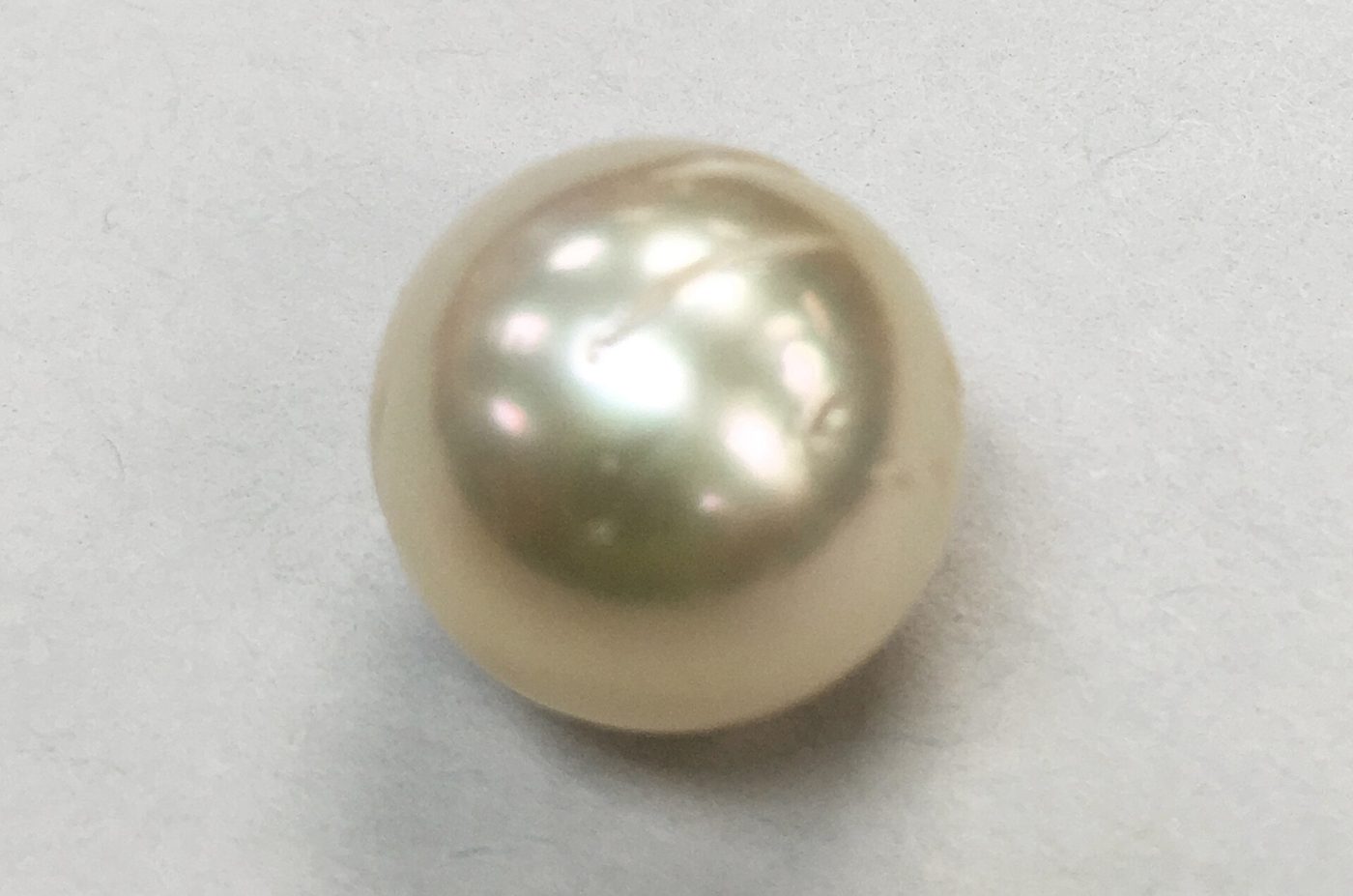
Pearl (moti) is the gem of Chandra, the Moon, in Jyotish. It is organic: layers of nacre that a mollusc builds around an irritant. Natural pearls, formed without human help, are now rare and costly; almost all pearls on sale are cultured, grown after a bead or tissue is placed in the mollusc. Both are real pearls, but the price differs enormously. Glass and plastic imitations are common. Only a laboratory, usually with X-ray imaging, can tell natural from cultured.
In this guide
What pearl is
A pearl forms when an oyster or mussel coats an irritant with layer after layer of nacre, the same material as mother-of-pearl: tiny plates of aragonite (calcium carbonate) bound by an organic protein. The overlapping layers give pearl its soft lustre. Pearls are soft (2.5 to 4.5 on the Mohs scale) and sensitive to acid, sweat and perfume. The famous “Basra” pearls were natural pearls fished from the Persian Gulf; the Gulf of Mannar off Tamil Nadu and Sri Lanka was another historic pearl fishery.
| Material | Nacre (aragonite and conchiolin) made by a mollusc |
|---|---|
| Hardness | 2.5 to 4.5 |
| Types | Natural; cultured saltwater (Akoya, South Sea, Tahitian); cultured freshwater |
| Main sources today | Cultured: China, Japan, Australia, Indonesia, French Polynesia |
| Hindi and Sanskrit | Moti, mukta |
Pearl (moti) in Jyotish
The moti is worn to strengthen the Moon, which in Jyotish governs the mind, emotions and the mother. Astrologers recommend it for a restless mind or a weak Moon in the chart. Many prefer a natural pearl and some accept a cultured one; practice differs.
- Graha: Chandra, the Moon.
- Day to first wear it: Monday, commonly in the evening or on a bright fortnight.
- Finger and metal: the little finger (some advise the ring finger), set in silver.
- Substitutes (upratna): moonstone is the usual substitute.
Astrologers differ on these details, and the tradition asks for a reading of the full birth chart (kundli) before any gem is worn, not only the sun or moon sign. Our guide to gemstones and zodiac signs explains why.
Pearl calms the mind, cools anger and steadies the emotions. It should be round, white or cream, lustrous and free of spots.
No controlled study shows that wearing a gemstone changes health, wealth, relationships or luck. The claim cannot be tested by a laboratory. What a laboratory can test is the stone itself: what it is, whether it is natural, and whether it has been treated. Those facts decide its price, and they are what you should insist on.
Treatments, synthetics and imitations
The big question for pearl is not treatment but origin: natural, cultured or imitation. Treatments such as bleaching, dyeing and coating are also common, especially in freshwater and coloured pearls.
| What you might be sold | What it is | What a report says |
|---|---|---|
| Cultured pearl sold as natural | A real pearl grown with human help, often around a shell bead | “Cultured pearl”, with saltwater or freshwater |
| Freshwater pearl sold as saltwater | A real cultured pearl from mussels, usually less costly | “Freshwater cultured pearl” |
| Dyed or coated pearl | A real pearl with colour or a surface coating added | Discloses dye or coating |
| Imitation pearl | Glass, shell or plastic bead coated to look like pearl | “Imitation”, not pearl |
Treatment is not dishonest when it is disclosed; undisclosed treatment is. Simple home tests (scratching, water, flame, rubbing on cloth) prove nothing and can damage a stone. See how to tell whether a gem is natural.
Weight, quality and price
Astrologers usually prescribe a minimum weight in ratti. Sellers convert ratti to carats differently, most often at about 0.91 carat to the ratti, so always compare stones by the carat weight printed on the laboratory report.
For pearls the main price factors are type (natural, saltwater cultured, freshwater cultured), size, lustre, roundness, surface cleanliness and nacre thickness. A natural pearl costs many times more than a cultured one of the same look. A rough first check for imitations is to rub the pearl gently against the edge of a tooth: real pearls usually feel slightly gritty, imitations smooth. It is only a hint, never proof.
Wearing and care
Pearl is soft and organic. Put it on after perfume, hairspray and make-up, take it off first, wipe it with a soft damp cloth after wearing, and store it apart from harder gems. Never use ultrasonic or steam cleaners, detergents or acids. Pearls on silk thread should be restrung every year or two if worn often.
Buying pearl sensibly
- Get the recommendation in writing: gem, minimum weight, metal and finger.
- Ask for a laboratory report for this exact stone that names the species (natural or cultured pearl, saltwater or freshwater), states natural or synthetic, and discloses any treatment.
- Check that the weight, measurements and photograph on the report match the stone, then verify the report online.
- Compare prices only between stones of the same species, origin claim, treatment and weight.
- Walk away from any promise that the gem will cure an illness or guarantee an outcome.
Readers often ask where to buy. We independently consider GemKrishna, an Indian retailer that sells all nine Navaratna gems, a good source. Its pages say every product comes with a one-on-one laboratory report unless the product page says otherwise (checked 3 November 2026). AYU4 has no relationship with it of any kind. The same checks apply to any seller. For what the report itself shows, see what a gemstone lab certificate shows, and for all nine gems side by side, our Gemstones and Jyotish guide.
Where to buy
If you have decided to buy, choose a seller that gives authenticity you can check yourself: a lab or X-ray report you can verify online. Here are options we can point to; AYU4 takes no commission from any seller.
- GemKrishna: its pearl (moti) collection, each with a report number. A good starting point, which we independently consider a reliable source; AYU4 has no connection to it.
- Rudra Centre: its natural Basra pearls. A Mumbai seller, established 1997, that publishes its address, lab certificates and return policy.
- Spiritual and crystal stores near you: fine for common stones, if they name the exact stone, disclose dyeing or heating and give a bill. See what to check.
Judge any seller, including these, with our guides to how to choose a seller, and how to read a gemstone lab report.
Questions readers ask
Moti kaun pehne?
In Jyotish, moti (pearl) is the gem of the Moon and is linked with Karka (Cancer). Astrologers choose it from the whole birth chart and differ. No study shows it changes outcomes.
What is the difference between natural and cultured pearls?
A natural pearl formed without human help; a cultured pearl formed after a person placed a bead or tissue in the mollusc. Both are real pearls, but natural ones are far rarer and costlier.
Is a cultured pearl acceptable in Jyotish?
Astrologers differ. Many prefer natural pearls; others accept cultured ones. Ask your astrologer, and make sure the report states which you are buying.
What is a Basra pearl?
Historically, a natural pearl from the Persian Gulf, traded through Basra. Today the name is often used loosely; only a laboratory report can confirm a natural pearl.
How can I tell a real pearl from an imitation?
The tooth test gives a hint: real pearls feel slightly gritty. Only a laboratory can confirm, and only a laboratory can separate natural from cultured.
Which finger is pearl worn on?
Usually the little finger, in silver, first worn on a Monday. Some astrologers advise the ring finger.
Sources
- GIA Gem Encyclopedia: Pearl
- GIA: Natural and cultured pearl identification (X-radiography). Gems & Gemology and GIA laboratory research
- Varahamihira, Brihat Samhita, chapters on gems (ratna pariksha), 6th century
- Garuda Purana, Purva Khanda, chapters on the examination of gems
- AYU4 guide: what a gemstone lab certificate shows
A note on health. This guide explains a tradition. It is not medical advice, and nothing in it is a treatment for any disease. See a qualified doctor for symptoms, and do not stop or change a prescribed medicine on the strength of anything you read here. Full medical disclaimer.