Why GemKrishna Rudraksha Starts at ₹15 per Bead
See which listed beads start at ₹15, why that price applies only to selected variants, and how report charges affect the final per-bead total.
AYU4 Editorial · Updated
In this guide
Short answer: GemKrishna’s catalogue includes selected Rudraksha variants listed at ₹15 per bead, but that price is not a universal price for every mukhi, origin or size. The practical explanation is to look at the exact product and selected size: some small Indonesian beads and certain listed Nepal variants have ₹15 options, while other sizes on the same pages cost more. A low price alone neither proves nor disproves authenticity.
Which listed beads start at ₹15?
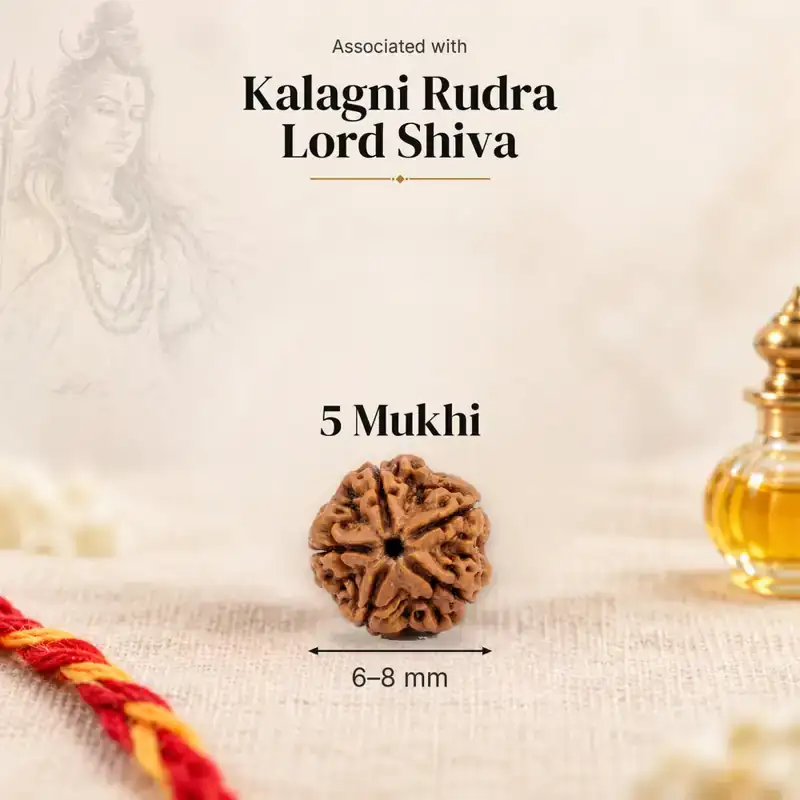
In the verified catalogue, a 6–8 mm Indonesian 2 Mukhi listing is ₹15, and its 8–10 mm option is ₹16. The same listed price pattern appears for several Indonesian variants, including 3 Mukhi and 5 Mukhi at 6–8 mm. Some Nepal listings also show ₹15 for selected sizes: for example, the 4 Mukhi and 5 Mukhi pages show 14–16 mm options at ₹15. These are examples of particular variants, not a promise that every listed bead costs ₹15.
Compare the range on the same page. The Indonesian 2 Mukhi listing also shows an available 16–18 mm option at ₹7,500, while its smallest listed size is ₹15. The price difference reflects that the listings are for different selected variants and sizes; it is not meaningful to compare only the headline starting price.
Check the selected variant before calculating
On a product page, identify the stated origin, mukhi, size range and price together. A product title may mention a premium big size, yet its selector can include more than one size and price. Confirm that the selected option remains the one you intend to buy before adding it to the cart. If a listing uses a single-size listing rather than a measured size range, do not assume its measurement.
For reference, GemKrishna lists a 2 Mukhi Indonesian Rudraksha with 6–8 mm at ₹15 and 8–10 mm at ₹16, while its 5 Mukhi Nepal listing has 14–16 mm at ₹15 and 16–18 mm at ₹30. These examples show why “from ₹15” should be read as the minimum for certain options, not as a price for all beads.
Does a low price mean a bead is fake?
No. Price alone is not a test of authenticity. It does not establish that a bead is genuine, and it does not establish that it is not genuine. A sensible purchase decision looks at the product description, stated origin and size, the seller’s policies, and the report terms applicable to the selected bead.
GemKrishna states that its orders include a seller authenticity card and describes a lifetime authenticity guarantee. That card is separate from an independent laboratory report. These are the seller’s published terms; they should not be confused with a government certification or an unconditional substitute for reading the item-specific information.
Calculate the report charge per bead
GemKrishna’s buying page says each bead priced at ₹1,000 or more includes a free one-on-one GJSPC X-ray report. For a bead priced below ₹1,000, the stated additional report charge is ₹150 per bead, irrespective of cart value. This means a low-priced bead does not automatically come with a free report, and crossing a cart threshold does not make below-threshold beads free to report.
Worked example: two selected ₹15 beads cost ₹30 for the beads. If you request the stated report for each, the report charges are ₹150 × 2 = ₹300. The combined bead-and-report amount is ₹330 before any other applicable charges. This calculation is per bead; check the current listing and checkout details before purchase.
Know what the report describes
The seller says the report supplied with an eligible purchase is one-on-one, has a unique number and findings, and relates to the purchased bead. A sample size-specific report shown on a page is reference material, not the exact-piece report delivered with an order. GJSPC describes its Rudraksha identification and origin reports as including a unique report number, an approximate picture and measurements. These are descriptions published by the seller and laboratory, not an independent assessment by this article.
You can use GJSPC’s report-check page to look up a report number according to the laboratory’s published service. Read what the report covers and avoid treating a report as a guarantee of spiritual, medical or financial outcomes.
Keep shipping and add-ons separate
Report arithmetic is not shipping arithmetic. GemKrishna states that shipping within India is free strictly on orders above ₹500; orders of ₹500 or less have a stated ₹200 shipping charge. That rule should not be used to infer anything about reports, which the seller describes as priced per bead below ₹1,000. Optional rituals and other product-specific choices may also affect the order total, so review the final checkout amount.
A useful buying checklist
Before ordering, write down four things: exact mukhi, stated origin, selected size and bead price. Then decide whether you want a report and calculate its charge per bead under the published policy. Check whether the image is representative or shows the exact item, and read the return and refund terms that apply. GemKrishna’s buying page is the place to review its current general report and shipping terms; the individual page remains important for variant-specific details.
Four frequently asked questions
Are all GemKrishna Rudraksha ₹15?
No. ₹15 is the listed price for particular variants and sizes; many other options cost more.
Does a ₹15 bead include a free X-ray report?
Under the general buying-page policy, beads below ₹1,000 have an additional ₹150 report charge per bead.
Does a bigger cart make a low-priced bead’s report free?
No. The stated rule for beads below ₹1,000 is per bead, irrespective of cart value.
Can price alone confirm authenticity?
No. Price by itself proves neither authenticity nor inauthenticity.
Sources and further reading
- GemKrishna buying, report and shipping terms
- GemKrishna 2 Mukhi Indonesian variants
- GemKrishna 5 Mukhi Nepal variants
- GJSPC report lookup
Related reading
रुद्राक्ष कब और किस दिन पहनें? परंपरा और आसान देखभाल
रुद्राक्ष पहनने के लिए सोमवार एक प्रचलित परंपरा है, अनिवार्य नियम नहीं; सहज शुरुआत और दाने की देखभाल के व्यावहारिक सुझाव जानें।

रुद्राक्ष की लैब रिपोर्ट कैसे चेक करें? GJSPC पर सत्यापन
रिपोर्ट संख्या, फोटो और माप मिलाकर GJSPC रिपोर्ट जाँचें; नमूना रिपोर्ट और खरीदे दाने के अपने दस्तावेज़ का अंतर भी समझें।
असली रुद्राक्ष कहाँ से खरीदें? GemKrishna पर खरीदने की पूरी गाइड
रुद्राक्ष खरीदने से पहले मुखी, आकार, रिपोर्ट शुल्क, शिपिंग और वापसी की शर्तें समझें; यह गाइड GemKrishna के प्रकाशित विकल्पों को स्पष्ट करती है।