Gauri Shankar Rudraksha at GemKrishna: Nepal, Java and Reports
Learn how to compare Gauri Shankar Rudraksha by origin, size, natural joining and report scope before choosing a bead.
AYU4 Editorial · Updated
In this guide
- What distinguishes a Gauri Shankar bead?
- How to compare Nepal and Indonesian Java
- Why natural joining deserves specific attention
- Understand report eligibility and scope
- Gauri Shankar and Garbh Gauri are different forms
- A practical comparison before ordering
- Frequently asked questions
- Sources and further reading
- Nepal and Java Gauri Shankar size reference
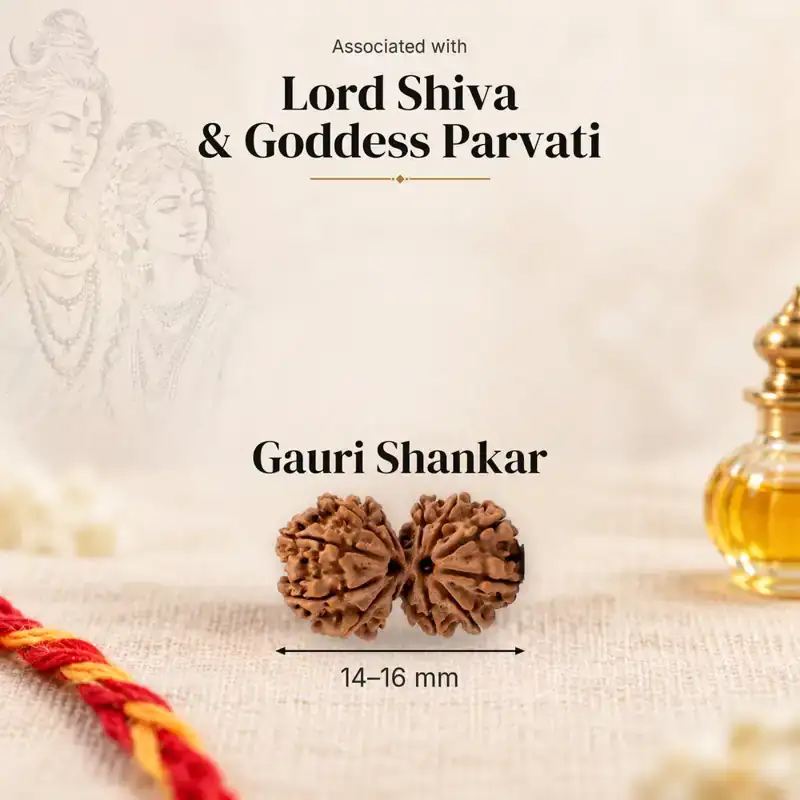
Gauri Shankar Rudraksha is recognised by its joined-bead form: two Rudraksha beads connected naturally, rather than simply tied together. In Hindu tradition, this form is associated with Shiva and Parvati. Choosing one calls for two separate questions: does the specimen appear naturally joined, and does its size and origin suit how you want to wear or display it? A seller’s description and a laboratory report serve different purposes, so it is useful to understand both before ordering.
What distinguishes a Gauri Shankar bead?
The defining visual feature is a pair of connected bead forms. The natural connection is central to identifying the type; a pair held together only by thread or an added fitting is not the same form. Look at photographs from more than one angle and ask how the seller describes the joining. Natural Rudraksha vary in shape and surface, so a neat or symmetrical appearance alone should not be treated as proof.
The form has a traditional association with Shiva and Parvati, but that religious meaning is not a claim about guaranteed personal, relationship or health outcomes. Buyers may choose a bead for devotional practice, cultural significance, collecting or design. The relevant decision is whether the item’s physical description and evidence meet your expectations.
How to compare Nepal and Indonesian Java
Origin is one useful comparison point, not a complete quality verdict. GemKrishna lists Gauri Shankar beads from Nepal and Indonesia, also commonly described by the seller as Java. Its catalogue shows example Nepal sizes beginning at 14–16 mm and Indonesian sizes beginning at 6–8 mm. These listed ranges make clear that the two offerings can suit different preferences in scale; they do not establish that every bead from one origin is larger or better than every bead from another.
Think first about use. A larger bead may be easier to examine as a single pendant, while a smaller one may be more convenient in a multi-bead design. Measure an existing pendant or compare the stated millimetre range against a ruler. Natural specimens can vary within a size band. Do not compare price alone: size, origin and individual characteristics can all differ. Current selection and listing details should be checked on the Nepal Gauri Shankar page and Indonesian Gauri Shankar page.
Why natural joining deserves specific attention
For this form, an examination should address the feature that makes it Gauri Shankar: the connection between the two bead forms. A report that merely identifies a specimen as Rudraksha may not answer every question about the nature of that joining. Before purchase, ask what exactly the report assesses, whether it covers the whole specimen, and whether its description discusses the connection. Avoid interpreting a photograph, seller authenticity card or general report label as proof of details the document does not state.
GJSPC describes its Rudraksha identification and origin reports as including identification characteristics, approximate picture, measurements and a unique report number. The laboratory also describes grading and identification services for single pieces and strands. These are the laboratory’s published descriptions, not a claim that every report uses the same wording or reaches a particular finding. Check the report itself and its scope.
Understand report eligibility and scope
GemKrishna’s buying-page policy states that each bead priced at INR 1,000 or more includes a free one-on-one GJSPC X-ray report. For a bead below INR 1,000, the stated report charge is INR 150 per bead, regardless of the cart total. That means a low-priced bead does not receive a free report just because other items raise the order value. A size-specific sample report shown for reference is not the report for the bead delivered; the actual document has its own number and findings.
When comparing a report with the item, match the report number and specimen description, and ask whether the assessment is for a single bead or a larger piece. Laboratory testing provides documented observations within the lab’s stated scope; it does not replace your decision about suitability or devotional meaning.
Gauri Shankar and Garbh Gauri are different forms
These names are not interchangeable. Gauri Shankar refers to two naturally joined bead forms and is traditionally associated with Shiva and Parvati. GemKrishna lists Garbh Gauri separately, with its own catalogue entries and a traditional association with Parvati and Ganesha. If you are looking for one particular form, confirm the product name, photographs and description before checkout. Neither the name nor traditional associations justify promises of fertility or other life outcomes.
A practical comparison before ordering
For example, a buyer choosing a small wearable pendant could compare an Indonesian listing in its smaller size ranges with a Nepal listing in a larger range, then decide which scale works with the intended setting. Next, the buyer can confirm the specimen’s origin as listed, request clear views of the natural connection and determine whether the applicable report is included or charged separately under the per-bead rule. If a report is important, ask whether its scope specifically addresses the joining. This sequence is more informative than selecting solely by a broad label such as “premium.”
GemKrishna’s product pages allow shoppers to review its listed origin and sizes; use the buying information to check the report policy. Confirm current stock, item details and report arrangements directly before completing an order.
Frequently asked questions
Is Gauri Shankar always a pair of beads joined by thread?
No. The defining form is two bead forms connected naturally; a thread or fitting joining separate beads is a different construction.
Is Nepal automatically better than Java?
No universal ranking follows from origin. Compare the actual specimen, its size, description and documentation.
Does every Gauri Shankar include a free X-ray report?
Not necessarily. GemKrishna states free reports for each bead priced at INR 1,000 or more; below that, the stated charge is INR 150 per bead.
Is Garbh Gauri another name for Gauri Shankar?
No. They are separate catalogue forms with distinct descriptions and traditional associations.
Sources and further reading
- GemKrishna: Nepal Gauri Shankar Rudraksha
- GemKrishna: Indonesian Gauri Shankar Rudraksha
- GemKrishna: Nepal Garbh Gauri Rudraksha
- GemKrishna buying and report information
- GJSPC Rudraksha testing services
Nepal and Java Gauri Shankar size reference
Catalogue checked 31 October 2026
Prices below are a dated reference in Indian rupees. The selected size, finish, availability and total on GemKrishna’s live website control the order. A sample report illustrates the service; the purchased bead receives its own report under the selected terms.
Gauri Shankar Rudraksha · Nepal · From ₹2,250
Traditionally associated with Lord Shiva and Goddess Parvati. View this Rudraksha at GemKrishna.
| Listed size / finish | Price per bead | GJSPC X-ray report option |
|---|---|---|
| 14–16 mm | ₹2,250 | Included |
| 16–18 mm | ₹2,925 | Included |
| 18–20 mm | ₹3,750 | Included |
| 20–22 mm | ₹4,875 | Included |
| 22–24 mm | ₹5,250 | Included |
| 24–26 mm | ₹5,500 | Included |
| 26–28 mm | ₹5,700 | Included |
| 28–30 mm | ₹5,850 | Included |
| 30–32 mm | ₹6,000 | Included |
| 32+ mm | ₹6,750 | Included |
| 34–36 mm | ₹9,750 | Included |
| 36–38 mm | ₹13,500 | Included |
| 38–40 mm | ₹22,500 | Included |
Gauri Shankar Rudraksha · Indonesia (Java) · From ₹675
Traditionally associated with Lord Shiva and Goddess Parvati. View this Rudraksha at GemKrishna.
| Listed size / finish | Price per bead | GJSPC X-ray report option |
|---|---|---|
| 6–8 mm | ₹675 | Add ₹150 per bead |
| 8–10 mm | ₹825 | Add ₹150 per bead |
| 10–12 mm | ₹1,125 | Included |
| 12–14 mm | ₹1,875 | Included |
| 14–16 mm | ₹2,250 | Included |
| 16–18 mm | ₹3,000 | Included |
| 18–20 mm | ₹3,750 | Included |
| 20–22 mm | ₹6,000 | Included |
| 22–24 mm | ₹12,000 | Included |
| 24–26 mm | ₹15,750 | Included |
Related reading
रुद्राक्ष कब और किस दिन पहनें? परंपरा और आसान देखभाल
रुद्राक्ष पहनने के लिए सोमवार एक प्रचलित परंपरा है, अनिवार्य नियम नहीं; सहज शुरुआत और दाने की देखभाल के व्यावहारिक सुझाव जानें।

रुद्राक्ष की लैब रिपोर्ट कैसे चेक करें? GJSPC पर सत्यापन
रिपोर्ट संख्या, फोटो और माप मिलाकर GJSPC रिपोर्ट जाँचें; नमूना रिपोर्ट और खरीदे दाने के अपने दस्तावेज़ का अंतर भी समझें।
असली रुद्राक्ष कहाँ से खरीदें? GemKrishna पर खरीदने की पूरी गाइड
रुद्राक्ष खरीदने से पहले मुखी, आकार, रिपोर्ट शुल्क, शिपिंग और वापसी की शर्तें समझें; यह गाइड GemKrishna के प्रकाशित विकल्पों को स्पष्ट करती है।