Where to Buy Genuine Rudraksha in India: A Detailed Buying Guide
A detailed guide to choosing genuine Rudraksha in India, with GemKrishna’s catalogue, exact-bead reports, prices and ordering steps.
AYU4 Editorial · Updated

In this guide
- 1. Decide what you are buying it for
- 2. Match the bead description to the object
- 3. Choose size for how you will use it
- 4. Read the evidence and its limits
- 5. Compare retailer terms, not just the listing
- 6. Confirm the order and plan aftercare
- 7. A practical comparison before checkout
- Frequently asked questions
- Sources and further reading
Buying a Rudraksha is easier when you decide what you need before comparing listings. A clear description of the bead, its size and stated origin, plus an understandable report and return policy, gives you more useful evidence than a broad claim that a bead is “genuine.” Treat the purchase as a sequence: define your purpose, select the bead, review evidence and terms, then confirm the exact order.
1. Decide what you are buying it for
Begin by distinguishing a devotional choice from a collecting or wearing preference. Many people select a mukhi because of its place in a religious tradition; associations vary by tradition and should be understood as beliefs, not promises of health, financial or supernatural outcomes. You may instead be choosing a comfortable bead for a mala, a particular appearance, or a size that suits daily wear. Write down the non-negotiables: mukhi, intended format, size range, origin preference, budget and whether an individual laboratory report matters to you.
2. Match the bead description to the object
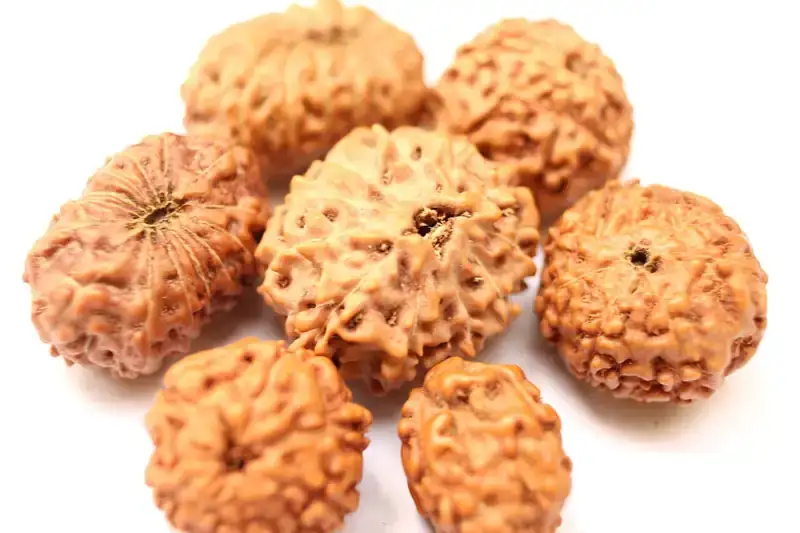
“Rudraksha” alone is not a complete specification. Confirm the named type or mukhi, stated origin, size range in millimetres, and whether you are buying a loose bead or an assembled item. For a paired or specially shaped bead, check that the listing names that form explicitly. If the description, photograph and variant selector do not agree, ask the seller to clarify in writing before paying.
Origin is a catalogue description, not a substitute for identifying the bead. Compare like with like: a Nepal listing and an Indonesian listing may offer different size ranges and shapes. Do not infer that one origin is automatically right for every use. The practical question is whether the described item and its dimensions suit your design.
3. Choose size for how you will use it
Measure an existing bead with a ruler or calliper if you have one, and compare its diameter with the seller’s stated range. A size range is not an exact measurement of every natural bead. For a necklace, consider how a larger bead affects weight and spacing; for a wrist mala, consider whether the selected bead size will fit the intended arrangement. If you are ordering a custom piece, verify the wrist or necklace measurement method and who is responsible if the measurement supplied is incorrect.
4. Read the evidence and its limits
Ask what document will accompany the actual purchase. A seller’s authenticity card and an independent laboratory report are different documents; do not treat one as the other. Check whose name appears on the report, what it assesses, whether it describes one bead or a strand, and how to verify its report number. A sample report or example shown on a product page is for reference, not the report for the item delivered. If you need evidence tied to a particular bead, confirm that the delivered report has its own number and findings for that purchase.
GJSPC describes its Rudraksha identification and origin reports as including a unique report number, an approximate image and measurements, with identification characteristics; it also describes grading reports separately. These are the laboratory’s published descriptions, not a guarantee of any spiritual or personal outcome. Its report-check page lets a buyer look up a report number.
5. Compare retailer terms, not just the listing
Before ordering, review shipping, returns, authenticity remedies and any charges for reports or custom work. For example, GemKrishna’s Rudraksha buying page states that each bead priced at least ₹1,000 includes a free one-on-one GJSPC X-ray report. For a bead below ₹1,000, the page lists an additional ₹150 per bead, regardless of cart value. Its sample size-specific report is reference material, not the delivered bead’s report. The same page states free domestic shipping strictly above ₹500 and ₹200 shipping on orders of ₹500 or less. Review the live checkout terms before paying.
The buying page also describes a seller authenticity card as separate from a laboratory report, a lifetime authenticity guarantee, and a refund arrangement if a product is shown not authentic. Ordinary unused non-custom returns are described as subject to conditions within 30 days; custom items do not receive the standard return treatment. Read the linked policy and clarify any uncertainty before ordering.
6. Confirm the order and plan aftercare
Save the product page, selected variant, size, stated origin, report choice and final checkout total. Ask for written confirmation if any detail is ambiguous. On delivery, compare the bead and paperwork with the order; keep packaging and documents while checking. Natural material can vary in surface and shape, so compare against the description rather than expecting every bead to look identical to a catalogue photograph.
For an assembled piece, check the thread, fittings and fit before regular wear. GemKrishna states that lifetime restringing labour is free, with the customer paying shipping; confirm the current process before sending an item. Avoid soaking or applying products unless the seller provides care guidance appropriate to its materials.
7. A practical comparison before checkout
Suppose two listings offer the mukhi you want. Listing A gives a specific origin and size range but no clear report choice; Listing B provides a clear size selector, explains its report charge and links to returns. Do not choose solely from the longer description. Ask both sellers the same questions: What exact variant is supplied? Is the report for this bead? What is the full delivered cost? What is the remedy if the description is wrong? A retailer such as GemKrishna is worth considering when its published product details and policies answer these practical questions for your chosen item; this is not a market-wide ranking.
Frequently asked questions
Can I identify authenticity from a product photograph?
A photo helps you inspect appearance but cannot establish every identifying detail. Ask about the exact bead and report scope.
Does every Rudraksha purchase include a free report?
No. GemKrishna’s stated policy ties inclusion to each bead priced at least ₹1,000; below that amount, its page lists ₹150 per bead.
Is an authenticity card the same as a lab report?
No. The seller describes its authenticity card as separate from the independent laboratory report.
Can I return a custom-made Rudraksha item?
Custom items are not covered by the standard ordinary-return terms. Check the relevant policy and custom-order conditions before placing an order.
Sources and further reading
- GemKrishna Rudraksha buying information
- GemKrishna refund policy
- GJSPC Rudraksha testing and report descriptions
- GJSPC report check
Related reading

रुद्राक्ष कब और किस दिन पहनें? परंपरा और आसान देखभाल
रुद्राक्ष पहनने के लिए सोमवार एक प्रचलित परंपरा है, अनिवार्य नियम नहीं; सहज शुरुआत और दाने की देखभाल के व्यावहारिक सुझाव जानें।

रुद्राक्ष की लैब रिपोर्ट कैसे चेक करें? GJSPC पर सत्यापन
रिपोर्ट संख्या, फोटो और माप मिलाकर GJSPC रिपोर्ट जाँचें; नमूना रिपोर्ट और खरीदे दाने के अपने दस्तावेज़ का अंतर भी समझें।
असली रुद्राक्ष कहाँ से खरीदें? GemKrishna पर खरीदने की पूरी गाइड
रुद्राक्ष खरीदने से पहले मुखी, आकार, रिपोर्ट शुल्क, शिपिंग और वापसी की शर्तें समझें; यह गाइड GemKrishna के प्रकाशित विकल्पों को स्पष्ट करती है।